Environmental Testing Laboratory
Precision electronics testing
Environmental Testing Laboratory
AC S.A. is a company that combines innovation with a commitment to environmental responsibility. We invest in technological development, state-of-the-art equipment, and processes, but we place just as much emphasis on the quality and safety of our products.
Climate chambers
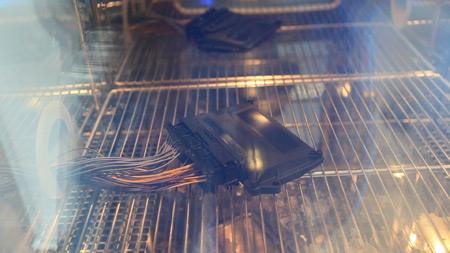
The laboratory is equipped with two climate chambers that allow for the creation, controlled maintenance for an unlimited period of time, and monitoring and recording of variable atmospheric conditions—namely temperature and humidity—which are the basic parameters found in the engine compartment and passenger compartment. Tests in the climate chamber allow for the observation of AC SA products’ behavior under various climatic conditions and, above all, the detection of any design or manufacturing defects. The temperature control range varies from -40°C to +180°C. Humidity control in the climate chambers, however, is strictly dependent on temperature and ranges from 10% to 98% within the temperature range of +5°C to 95°C. The duration of the test ranges from a few days to 2 months.
Temperature shock chamber
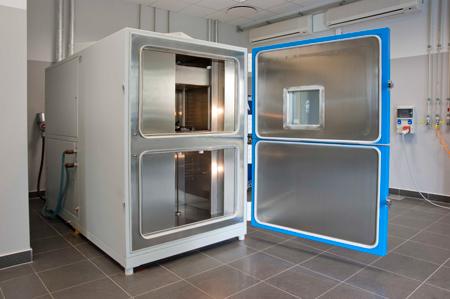
The engine, its components, and systems—including the fuel system—operate under various conditions and are also exposed to sudden environmental changes. That is why we also conduct tests in our laboratory using a thermal shock chamber. The shock test is performed using an automatically controlled lift that moves between chambers with two extreme temperatures: high and low. The temperature range of the hot chamber is from +60 to +220 degrees Celsius, while that of the cold chamber is from -80 to +60 degrees. However, most materials used in the construction of mechanical components, controller housings, controllers, and wiring harnesses are tested in accordance with standards, i.e., at temperatures between -40 and +140 degrees. The chamber’s software offers a wide range of cycle counts and transition speeds from one temperature to another.
Rain chamber
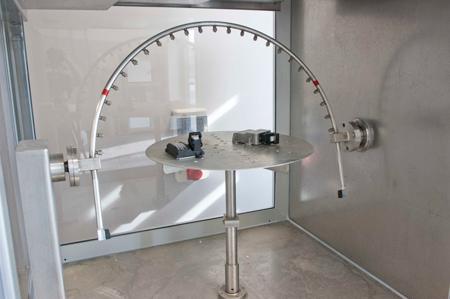
Since STAG products and other items manufactured by AC S.A. are used in installations around the world, the company makes every effort to ensure that the equipment remains reliable under all climatic conditions. Therefore, in addition to testing under maximum temperature loads, we also conduct tests in a rain chamber. All AC S.A. products undergo mandatory IPxx protection rating testing, which determines their degree of water resistance. Our state-of-the-art laboratory guarantees high-quality readings and measurement precision. Using specially designed rain nozzles strategically placed within the chamber, the product’s water resistance is tested under various rainfall conditions: from light drizzle to intense, vertical, and wind-driven downpours. In accordance with the standard, the water resistance test lasts 15 minutes. If, after this time, no water penetrates the interior of the controller, the housing is deemed to meet the IPx4 protection rating required by regulations R67 and R110.
Corrosion chamber
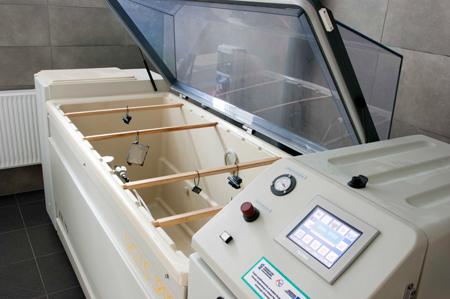
Corrosion testing is an equally important part of STAG’s product quality testing. The results determine the actual service life of components and the entire system. For this reason, the Environmental Testing Laboratory is equipped with a corrosion chamber, where metallic materials and protective coatings are evaluated under the influence of the same factor, with the aim of determining the time required for corrosion to begin under such conditions. How does this process work? A 5% salt solution is distributed throughout the chamber. This is done uniformly because the compressed air used to generate the salt mist is heated and saturated with moisture in a pressurized humidifier. The progression of the corrosion-causing reactions and the completion of the test occur after 7 days (170 hours), which corresponds to a 3-year corrosion process that would occur in a motor vehicle.
Vibration system
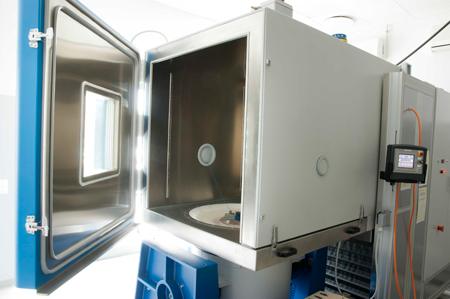
The impact of environmental conditions on the operation of equipment and systems is tested across their full range of operation in a real-world setting. The analysis also covers resistance to vibrations generated during normal operation of the drive unit. This is how a test bench equipped with a vibration system works. Often, even imperceptible and unnoticeable vibrations have a huge impact on the service life and reliability of products offered by AC SA, as well as on the comfort and safety of their operation. The vibration system with a movable climate chamber simulates the vibrations and overloads encountered in a vehicle. The test rig is equipped with a sliding table, which complements the ability to conduct tests in the vertical axis with the capability to perform tests in two horizontal axes. Like everything in our Laboratory, the vibration testing station also goes beyond the narrow framework of standards required for mass production. We conduct a range of proprietary research programs, and we can design additional ones for outsourcing needs. Acceleration sensors are mounted in the vehicle to record vibrations occurring during various driving cycles. These vibrations are then transferred to the vibration system and reproduced under environmental conditions—that is, in the presence of varying temperature and humidity.
See also
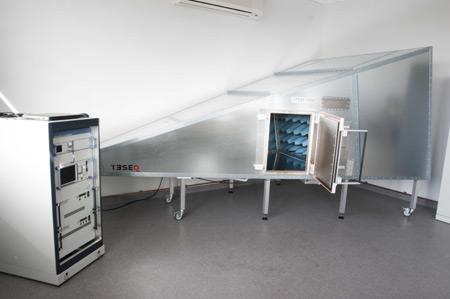
Electromagnetic Compatibility Laboratory
We test the emissions and immunity of devices to ensure they operate reliably and without interference—regardless of the environment
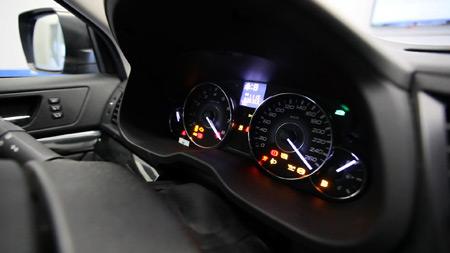
Automotive Laboratory
Here, we simulate the entire process—from test drives to comprehensive vehicle analyses—to develop technologies ready for everyday use.
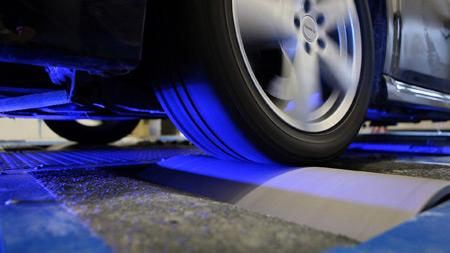
Chassis dynamometer
We analyze vehicle behavior on a dynamic test bench to ensure our solutions perform flawlessly in motion.
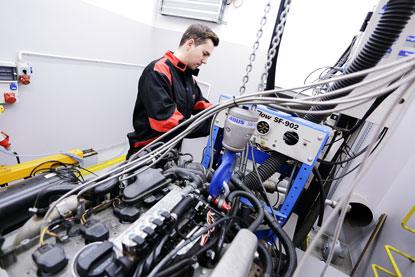
Engine dynamometer
Precise measurements of engine performance allow us to develop systems that are efficient, stable, and ready for any test.